
During the time I call the “blurry years,” when my children were young and life was often hectic, someone in the family, likely my late father Lucien, gave me documents showing the Aubé and Labrecque lineages. Although I immediately forgot the details of receiving these documents, I luckily had the reflex to safely store them away and finally, after many years, found them and took them out for a look.
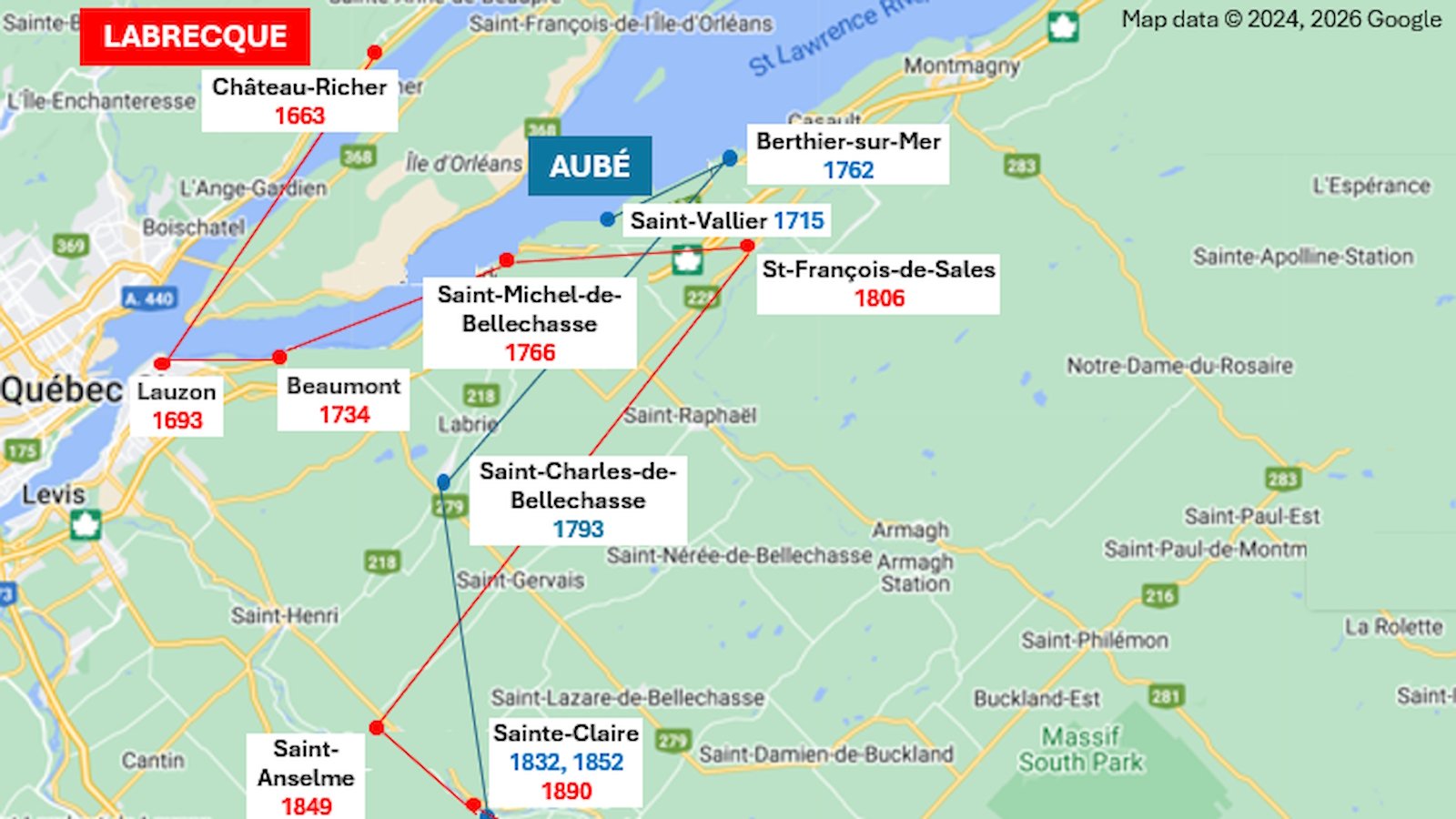
Each document consists of a list of the couples who engendered the lineage, with the date and place of their marriage. One day, curiosity led me to plot the marriage places on a map, and voilà, you have what I’ve named the “matrimonial routes map” below. It traces the mobility of the Aubé family (the blue line) and the Labrecque family (the red line) over the generations based on the places of marriage.
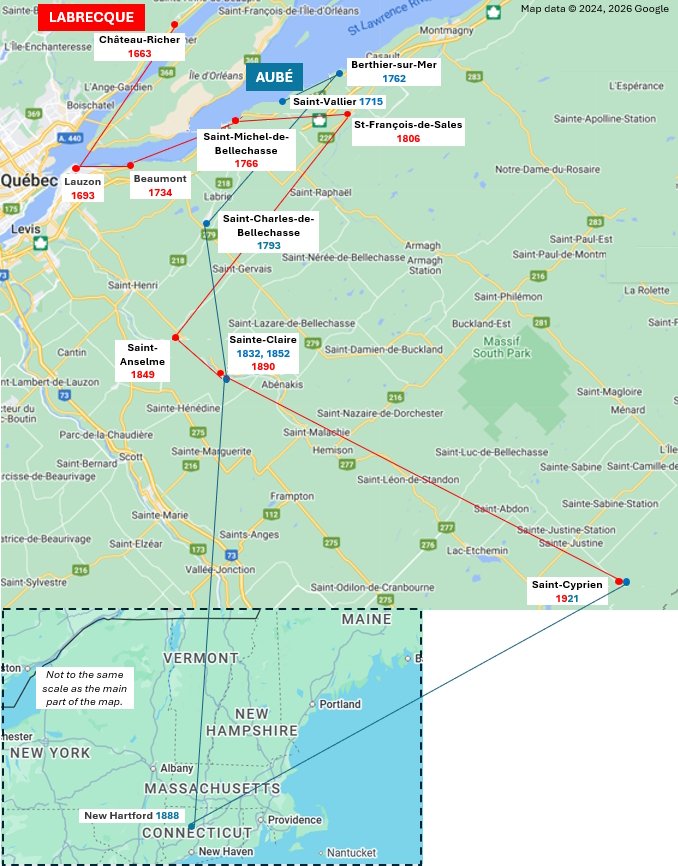
My grandparents Albert Aubé and Éva Labrecque married in 1921 in Saint Cyprien, Quebec, where their respective families had recently arrived. Prior to that, their families had moved from one village to another with practically every generation. I find it remarkable that both families followed nearly parallel paths.
The first generation of both families lived on the St. Lawrence River near Quebec City. Generation by generation, they moved along the coast, and then inland, south and southeast, eventually settling near the border with Maine in Saint Cyprien. There, lands were being opened for colonization, attracting people to the lumber and farming possibilities. One marriage took place farther south in New Hartford, Connecticut, where my great-grandparents, Theodore Aubé and Desange Émond, married in 1888. Theirs is a fascinating story that I’ll get to in a future post.
Traditionally, couples married in the parish of the bride, though they didn’t necessarily set up their household in her village, as we’ll also see in later posts. I’m pleased that the matrimonial routes map gives prominence to the brides’ origins, for typically the male line receives more visibility in genealogy because it is used in tracing family descent.